Warehouse Quality Assurance Manual
Sep 23, 1997 - Director of Quality. QA Inspectors. Sales Manager. Off ice Areas. WarehouseIPackaging Areas. Certification Authority. Customers as Listed in.
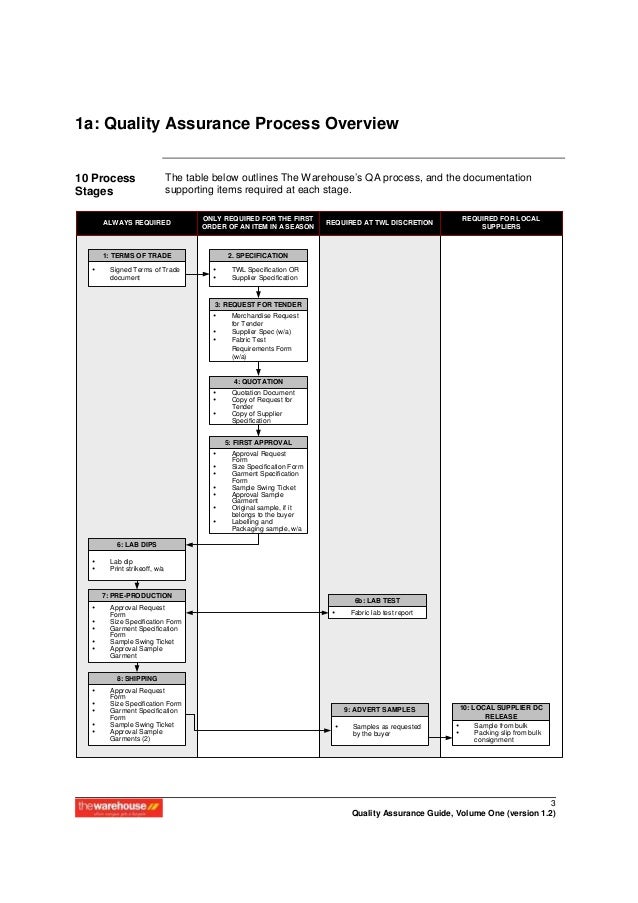
Apparel quality assurance manual. 1. Suppliers’Quality Assurance Manual Volume One: Process Guidelines The Warehouse Limited Version 1.2 March 2008. Table of ContentsINTRODUCTION. 1SECTION ONE: THE QA PROCESS.
2 1a: Quality Assurance Process Overview.3 1b: QA Process Descriptions.4 1c: Quick Guides to Submissions.8 Quick Guide to Submissions: First Approval Samples.9 Quick Guide to Submissions: Pre-production Samples.10 Quick Guide to Submissions: Shipping Samples.11 Quick Guide to Submissions: Advertising Samples.12 Quick Guide To Submissions: Local Supplier DC Release Samples.13 1d: Compliance Guidelines.14SECTION TWO: FABRICS AND ACCESSORIES. 15 2a: Fabric and Accessories: General Quality Requirements.16 2b: Fabric-Specific Quality Requirements.16 2c: Accessories Quality Requirements.17 2d: Submission and Approval of Fabrics and Accessories.19 2e: Testing of Fabric, Accessories and Labelling.20 2f: Mandatory Fabric Tests.22 2g: Testing Laboratories.25SECTION THREE: GARMENT CONSTRUCTION. 26 3a: General Requirements.27 3b: Product Safety.31 3c: Manufacturing Safety.32SECTION FOUR: LABELLING AND PACKAGING. 33 4a: Label Approvals and Testing.34 4b: Packaging Approvals and Testing.35 4c: Label and Packaging Compliance.35 4d: Label Attachment.38 4e: Shipment Packing.39SECTION FIVE: FINAL INSPECTION TO AQL STANDARD.
40 5a: What is AQL?.41 5b: How should an AQL inspection be carried out?.42 5c: If the Inspection fails: Re-inspection and Corrective Action.47 5d: AQL Sample Lots and Rejection Points.48 5e: AQL Defect List for Garments.49. IntroductionWhat is this This manual explains The Warehouse Limited’s apparel QA processes, and themanual for? Standards that all our Suppliers will be tested to when producing apparel for us. It is intended for use by all our apparel Suppliers, to familiarise themselves with our expectations prior to tendering for work; and, subsequently, as a reference guide to help Suppliers through the manufacturing phase.Contents The manual is comprised of two volumes.
Volume One (this volume) describes the process and provides guidelines for what Suppliers are expected to do. It should be read in full by all Suppliers, prior to tendering.
. 1. 2. 2.1.
2.2. 2.3. 3.
4. 5. 6. 7. 8. 8.1. 8.2.
8.3. 8.4. 8.5.
8.6. 9. 9.1. 9.2.
9.3. 9.4. 10. 11. 12 Introduction Quality Control (QC) is an aspect of logistics management that is rarely applied, partially applied or completely ignored. More so in emergencies where speed of delivery over-shadows aspects or activities that would otherwise provide checks and balances in a sector that already has so much at stake.
For the purpose of the LOG, simple aspects of QC are highlighted to provide basic knowledge that can be applied in emergency situations. In an emergency situation, it is not practical to initiate complex, involved quality control processes.
Some organisations are likely to already have institutional specific QC processes in place. Why quality management is important in humanitarian activities and humanitarian logistics:. the need to demonstrate the ability to consistently provide product/services that meets user, donor and applicable statutory and regulatory requirements;.
the goal of enhancing user satisfaction through the effective application of the system, including processes for continual improvement of the system and the assurance of conformity to user and applicable statutory and regulatory requirements; and. to support the achievement of sustained success. These systems assist in ensuring professional and high quality service delivery, leading to improved outcomes/less suffering for beneficiaries. Definition Quality Control (QC). The operational techniques and activities that sustain the product or service quality to specified requirements.
Operations intended for the assessment of the quality of products at any stage of processing or distribution. Part of quality assurance intended to verify that components and systems correspond to predetermined requirements. QC is therefore the process of ensuring that products/services required are received as is prescribed, in a timely, cost effective and efficient manner, through the application of well established systems and procedures. A QC system will therefore also measure whether standard operating procedures are in place, that they operated effectively and were strictly adhered to. Quality Assurance “Planned and systematic action that is necessary to provide adequate confidence that a product or service will satisfy given requirements for quality.” Quality Improvement: It can be distinguished from QC in that quality improvement is the purposeful change of a process to improve the reliability of achieving an outcome. In the humanitarian context it is sometimes defined as: 'the minimum level of performance that fulfils a requirement.'
Or '.the compliance with the technical specifications initially elaborated during the needs assessment.' (Action Contre la Faim- ) Some terminologies that are commonly used in relation to quality are: performance, compliance, standards, specification and conformity.
Logistics QC (LQC) is by no means a measure of quantitative throughput or output. Nor is it intended to set-up competition between different operating logistics functions, but a mechanism that ensures that needs are satisfactorily met.
Inevitably, at the onset of an emergency, some systems may not function well. Certain operational procedures may be absent.
Clearly, LQC has implications for efficiency, cost effectiveness and output. Where all standard logistics procedures are shown to be operating correctly, there is less likelihood of waste or delay. LQC allows the logistics officer to quickly identify areas for immediate attention.
The periodic running of LQC will allow the Logistics officer to maintain his/her operation efficiently and to avoid the erosion of standards. Nature of quality control QC is cross cutting through the entire logistics function. It enhances efficiency, effectiveness, and differentiation throughout. There are three related areas of focus for value creation: Goals. Objectives must be set for achieving internal and external user satisfaction. This involves finding out exactly how 'users' perceive the services rendered by the logistics function as a whole. Determine and assign responsibility for systems and processes that are necessary for creating and sustaining user satisfaction.
In many instances, this responsibility spans traditional functional boundaries and may even require re-engineering of some processes. User needs and expectations must be incorporated into the process of logistics delivery, transforming basic functions into benefits that yield value.
QC, when used in conjunction with monitoring and evaluation, leads to a formalisation of the quality process. Quality Control Tools. Check-lists. Questionnaires. Inspection procedures.
These can be internal or through outsourced companies such as SGS , Bureau of Veritas , Cotecna , etc. The inspection may be based on:. chemical Composition;.
physical attributes; and. standard operating procedures adopted.
Formulation of a QC Process The evolution of a QC process, is a movement through four distinct phases with notable characteristics:. Quality Control (QC). Quality control entails the basic procedural and statistical management of quality:. defect-free services;.
management-driven. Quality Assurance (QA). A greater emphasis on achieving user/user satisfaction through user/user-driven quality characterises. This is the shift from QC to QA:.
100% satisfied user/user;. user-driven. Total Quality Management (TQM). All stake holders, i.e.
Management, suppliers, users/users and employees all aligned and working together towards a common goal and ensuring quality service provision. It would cover monitoring of all aspects of management, staff, users/users satisfaction, systems implementation, adherence to processes and procedures and supplier performance. The above characterise the evolution to TQM. Significant gain for all stakeholders.
Common goals. User Value. User value reflects the need to do things that create the best competitive net value for the user.
Quality Control Cycle Systems and processes are a part of QC. QC is used in developing systems that ensure that goods and services delivered meet or exceed user expectations.
It not only verifies the delivery of good quality but also identifies gaps and failures that need to be addressed. Diagram 1: Quality Control cycle Management system Management system refers to what the organization does to manage its processes, or activities, so that its products or services meet the objectives it has set itself, such as:. satisfying the customer’s quality requirements;. complying with regulations, and. meeting environmental objectives. Management system standards Management system standards provide a model to follow in setting up and operating a management system. This model incorporates the features on which experts in the field have reached a consensus as being the international state of the art.
Implementing a Quality Control System Application in Humanitarian Logistics. Development of standard procedures and processes to assist in the rapid establishment of logistics.
Sample Quality Assurance Manual
These systems assist in ensuring professional and high quality service delivery, leading to improved outcomes/less suffering for beneficiaries. Quality control of supplies – ensuring supplies meet specified requirements. Working with suppliers to create specifications of items that are easy to make (lower cost, higher quality, quick to produce) and meet user requirements for example, tarps, tents, etc. QC tools and techniques in Cold Chain. Provide some examples of tools used such as quality checklist mentioned above and tools used to ensure products meet specifications such as the use of inspection agents.
Set the parameters or bench mark This process is initiated when users place requests for products or services. When submitting a request, the requester of a product has to provide the logistician with the technical specifications. Note: different standards will apply for different products or services. For products on international markets, international standards define most of the requirements. Within the humanitarian community, there are specific relief standards set for commonly used products.
Some common sources are the sphere book, interagency set-ups or organisational specific catalogues. See in the Annexes for more information.